
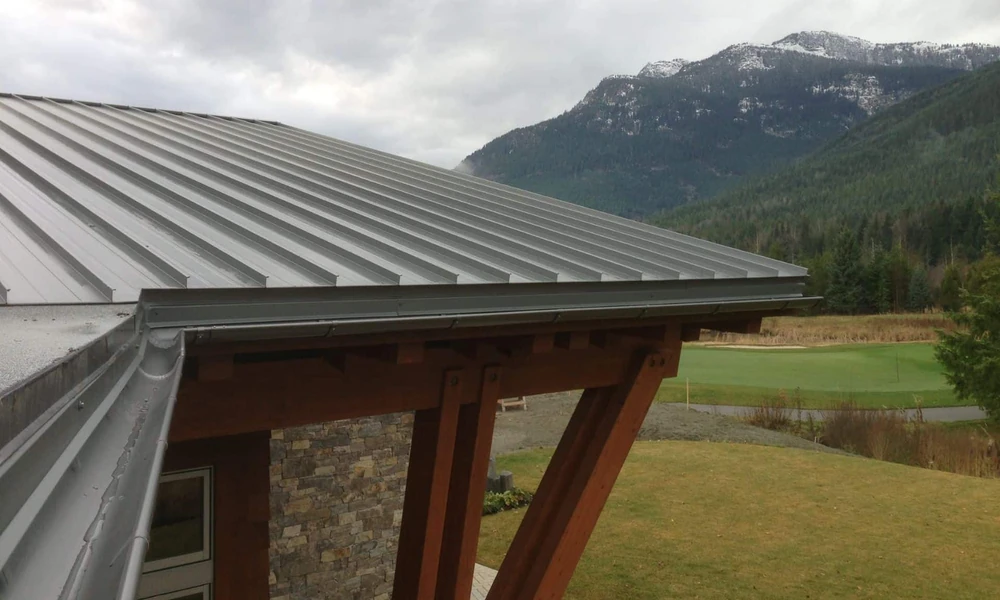
An inch of rain falling on 1,000 square feet of roof adds up to roughly 620 gallons of water. Most houses in southeast Kansas have well over that much roof, and spring storms here don’t spread an inch politely across an afternoon. They dump it in bursts, sometimes most of it in a quarter of an hour, with the wind pushing sheets of water sideways across the shingles.
That burst is what a gutter system has to survive. Average yearly rainfall barely matters when you’re choosing gutters. What matters is the heaviest short stretch of rain your roof is likely to see, because that’s the moment water either moves through the system or spills over the front edge and lands beside the foundation.
Around Coffeyville, Independence and Cherryvale, homeowners looking into gutter installation in Montgomery County can turn to the roofing and general construction crew at purevaluerenovations.com, a registered Kansas contractor offering free estimates and payment plans for exterior projects. Whoever ends up hanging the metal, the decisions below shape whether a new system actually keeps up when the sky opens.
Running the Numbers Before Picking a Profile
Gutter sizing follows a simple method that installers and roofing references have used for decades. It looks at three things, which are how much roof drains into each run, how steep that roof is, and how hard rain falls in your area during its most intense five minutes. Steeper roofs catch more wind-driven rain and send it to the eave faster, so they count as more area than their footprint suggests.
Here is how the math works out on a typical back slope.
- Measure the flat footprint of the roof section draining into one gutter run. A rear slope 40 feet long and 30 feet deep covers 1,200 square feet.
- Find the pitch factor. A 6-in-12 roof uses 1.1, while a steep 12-in-12 roof jumps to 1.3.
- Multiply by the local peak rainfall intensity in inches per hour. Using 7 as an illustrative figure, the slope works out to about 9,240 adjusted square feet.
- Compare that result against gutter capacity. A standard 5-inch K-style gutter handles roughly 5,500 adjusted square feet, and a 6-inch K-style handles close to 8,000.
In that example even a 6-inch gutter falls short on a single run, so the answer is splitting the slope with two downspouts or adding a center outlet.
Downspouts Usually Decide the Outcome
Homeowners tend to focus on the gutter itself, but downspouts are often the real bottleneck. A gutter can only empty as fast as its outlets allow. Standard 2×3-inch downspouts are common on older homes, while 3×4-inch downspouts carry about twice the water and clog far less often with leaves and seed pods.
Spacing matters too. A long gutter run with a single outlet at one end forces water to travel the full length before it can drop, and during a downpour the far end overflows long before the outlet is working at capacity. Adding a second downspout often fixes chronic overflow better than upsizing the gutter.
Metal, Gauge and the Hail Question
Seamless aluminum is the everyday choice in this part of Kansas, rolled from coil on a machine in the installer’s truck and cut to the exact length of each wall. With no joints along the run, there are only corners and end caps left to seal. Gauge is worth asking about, since .032-inch aluminum resists denting noticeably better than the thinner .027-inch stock some bids quietly assume.
Galvalume steel costs more but shrugs off hail that would leave aluminum looking pockmarked. Copper lasts for generations and develops a patina, though the price limits it to historic homes and accent work. Vinyl is cheap and easy for weekend projects, yet it turns brittle in cold snaps and tends to sag under heavy loads.
Hardware Nobody Notices Until It Fails
Gutters full of water are surprisingly heavy, and an ice storm can add hundreds of pounds along a single wall. Modern hidden hangers screw through the gutter into the fascia board, ideally reaching the rafter tails behind it, and are typically spaced about two feet apart. Old spike-and-ferrule systems work loose over the years, which is why so many older gutters pull away from the house at one end.
The fascia board itself deserves a close look before anything goes up. Hanging new gutters on soft, water-stained wood just bolts fresh metal to a failing anchor. Replacing rotted sections during installation costs less than rehanging the whole run a few seasons later.
Slope finishes the job. A gutter should fall gently toward each outlet, often about a quarter inch for every 10 feet. Too little slope leaves standing water that breeds mosquitoes and corrodes seams, while too much makes the gutter look visibly crooked from the street.
Where the Roof Edge Meets the Gutter
Water doesn’t always land neatly in the trough. Without a drip edge or gutter apron tucked behind the back of the gutter, rain can wick around the shingle edge and run down the fascia, soaking the wood from behind. Valleys create a different problem, concentrating the runoff from two slopes into one fast stream that can shoot straight over the gutter at the corner. A small splash guard at those spots keeps the water where it belongs.
Leaves, Seeds and Guards
Debris here comes from oaks, sweetgum balls, cottonwood fluff in early summer and pine needles on some lots. Guards help, but no single style suits every yard. Fine stainless micromesh blocks needles and shingle grit yet needs an occasional brush-off. Reverse-curve hoods shed large leaves well but can overshoot in very heavy rain. Simple perforated screens cost the least and still let smaller debris through. Matching the guard to the trees overhead matters more than any brand promise of never cleaning again.
The Last Ten Feet Protect the Foundation
Much of southeast Kansas sits on clay that swells when soaked and shrinks during dry spells. A downspout emptying right at the corner of the house keeps that soil cycling between wet and dry, which over time can mean cracked slabs, sticking doors and damp crawl spaces. Extending discharge several feet out, and further where the yard allows, breaks that cycle. The EPA’s guide to redirecting downspouts shows simple ways to send roof runoff toward a lawn, garden bed or rain barrel instead of a paved driveway or the base of a wall. Underground drain lines ending at a pop-up emitter keep the lawn clear for mowing, while splash blocks and flexible extensions handle simpler setups. Grading that slopes away from the house finishes the job the gutters started.
A gutter system that looks tidy on a clear afternoon tells you very little. The real test comes on a stormy evening in May, when a few minutes of hard rain decide whether all those gallons end up well out in the yard or soaking into the clay right against the foundation.