
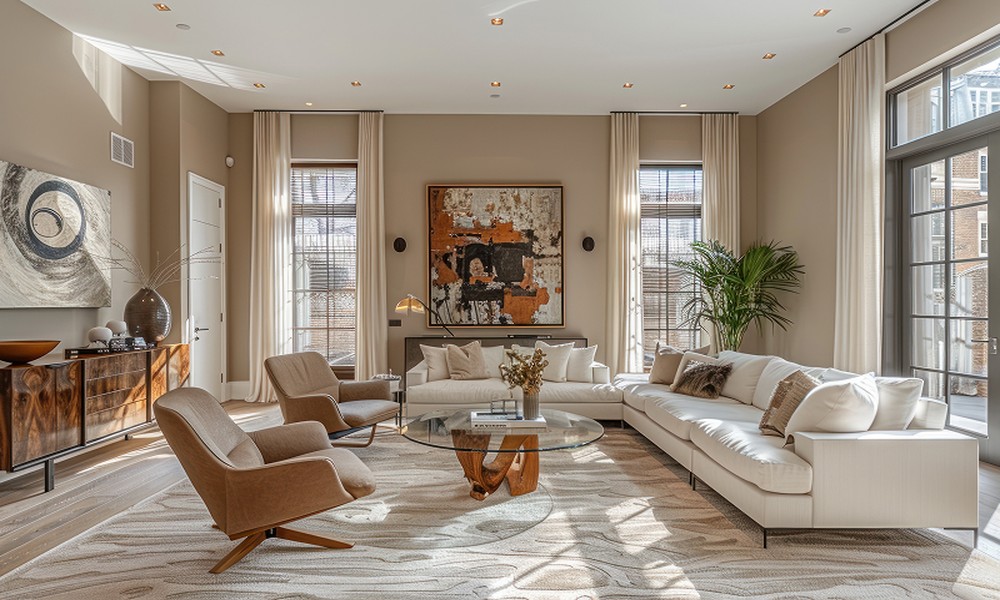
Key Highlights
- Luxurious Italian living room furniture is defined by craftsmanship, proportion, and material integrity, not just aesthetics.
- A cohesive interior concept requires a deliberate design language, not a collection of beautiful but unrelated pieces.
- Colour, texture, and scale are the three variables that either unify or fragment a living space.
- An Italian sofa in Singapore serves as the most effective anchor piece for building a room’s visual identity.
- Lighting and spatial flow are as critical to cohesion as the furniture itself.
Introduction
There is a reason why interior designers, collectors, and discerning homeowners consistently gravitate towards Italian furniture when crafting a serious living space. It is not sentiment or brand loyalty. It is the result of centuries of accumulated craft knowledge, where every curve, joint, and finish is treated as a considered decision rather than a manufacturing default.
Italian furniture design operates on a philosophy that form and function are never in competition. The silhouette of a well-made Italian piece has visual weight, the kind that grounds a room rather than floating awkwardly within it. When you invest in luxurious Italian living room furniture, you are not simply purchasing an object. You are acquiring a design anchor around which everything else in your space must make sense.
That distinction matters enormously when building a cohesive interior concept.
Start With a Design Language, Not a Mood Board
Most interior mistakes begin at the inspiration stage. Mood boards are useful tools, but they often seduce people into collecting aesthetics without committing to a coherent visual language. A cohesive living room is not an assembly of things that individually look beautiful. It is a space where every element speaks the same dialect.
Before selecting a single piece of furniture, define three things: your dominant material palette, your preferred silhouette family (whether that leans towards clean geometric lines or softer organic forms), and the level of ornamentation you intend to carry throughout the room. Italian design traditions cover an enormous range, from the restrained modernism of mid-century Milanese studios to the bold sculptural drama of contemporary Italian makers. Both are valid. Neither works if you mix them carelessly.
The Sofa as the Centrepiece Argument
In any living room, the sofa carries more compositional responsibility than any other piece. Its scale, upholstery, and placement determine how the rest of the room is arranged, perceived, and experienced. This is precisely why choosing an Italian sofa in Singapore deserves far more deliberation than most buyers give it.
An Italian sofa brings structural confidence to a room. The frames are typically built for longevity, the cushion profiles are precise, and the upholstery, whether leather or fabric, is selected for how it ages as much as how it looks on day one. When you position that piece correctly, ideally anchored to a rug that defines the conversation area, the rest of the furniture almost arranges itself.
Where many rooms lose cohesion is in treating the sofa as an isolated purchase rather than the foundation of a broader design argument. Every subsequent chair, side table, and surface should respond to the sofa’s material and formal character.
Colour, Texture, and Scale: The Three Variables
Cohesion does not require matching. It requires resonance. Italian interior design has long understood that a room becomes interesting when its materials are varied but tonally related. A pale stone coffee table beside a deep velvet Italian sofa in Singapore creates contrast, but if both pieces share the same underlying warmth in their tones, the room reads as unified rather than disparate.
Texture operates on the same principle. Smooth leather upholstery paired with a rough-weave textile cushion or a brushed metal side table introduces tactile variety without visual noise. The eye moves across these differences comfortably because the room has established a clear material logic.
Scale, however, is where most interiors quietly fail. Oversized furniture in a modest room, or delicate pieces dwarfed by a high-ceilinged space, creates a proportional dissonance that no amount of styling can fully correct. Luxurious Italian living room furniture tends to be designed with dimensional precision, but you must still assess it against your specific spatial envelope before committing.
Lighting Is Not an Afterthought
A thoughtfully furnished room can be completely undermined by poor lighting decisions. Italian interior design treats light as a material in its own right. Ambient, task, and accent lighting each serve a distinct spatial function, and layering all three is what gives a room its sense of depth and dimension.
For a living room anchored by luxurious Italian living room furniture, consider how natural light interacts with your upholstery and surface finishes at different times of day. Leather, lacquered wood, and polished stone all respond to directional light in ways that either enhance or flatten their character. Evening lighting should then complement this, using warm-toned sources at varying heights to create visual rhythm across the space.
Recessed ceiling lights alone produce a flat, institutional effect that works against the warmth that quality Italian furniture is designed to generate.
Spatial Flow and the Furniture Arrangement Principle
Beyond individual pieces, a cohesive interior concept depends on how furniture is arranged in relation to architectural features and circulation paths. Italian interior design philosophy consistently respects spatial flow, which means furniture is positioned to encourage movement and conversation rather than obstruct it.
A common arrangement error is pushing all furniture against the walls in an attempt to maximise floor space. The result is a room that feels sparse and disconnected. Drawing the furniture inward, anchored by a central rug, creates a defined zone that feels intentional and inviting. The space around the furniture becomes as deliberate as the furniture itself.
Conclusion
A cohesive living room is the product of considered decisions made in sequence, starting with a clear design language, built around a strong central piece, and refined through material, scale, and light. Luxurious Italian living room furniture provides the structural and aesthetic foundation for that process, but the coherence must be designed, not assumed.
Visit Colzani today and bring your interior concept to life with furniture that is genuinely built to last.