
A wet basement is one of the most common complaints among homeowners in the Chicago area, and the cause is often found well above ground. Every rainstorm and spring thaw sends a large volume of water off the roof, and the gutters funnel all of it into a few narrow downspouts.
Where that water goes next decides whether your foundation stays dry. A downspout that empties right beside the house concentrates runoff against the basement walls, while one that carries water to the right place protects the structure year after year.
How Much Water Your Roof Sheds
Roofs move far more water than most people expect. One inch of rain falling on 1,000 square feet of roof produces roughly 620 gallons of runoff. A typical Chicago-area home with a larger roof can send several thousand gallons through its downspouts during a single heavy storm.
Each downspout handles a share of that volume, often hundreds of gallons in a short period. When that water lands at the base of a foundation, it saturates the soil, builds hydrostatic pressure against basement walls, and finds its way through cracks, joints, and window wells.
The Minimum Distance From Your Foundation
Downspouts should discharge water at least 4 to 6 feet away from the foundation, and 10 feet is better where the yard allows it. Homes with finished basements, heavy clay soil, or a history of seepage benefit most from the longer distance.
Distance only works when the ground cooperates. The soil around a house should slope away from the foundation, and a common building standard calls for a drop of at least 6 inches within the first 10 feet. A properly sized gutter and downspout system paired with good grading keeps water moving away from the walls instead of pooling back toward them.
Common Ways to Redirect Downspout Water
Downspout extensions are the simplest option. Rigid or flexible extensions attach to the downspout elbow and carry water several feet across the lawn. They are inexpensive, though mowers and foot traffic can knock them loose, so they need regular checks.
Splash blocks sit under the outlet and spread the flow, but on their own they rarely move water far enough. They work best combined with an extension or on a lot where the grade already falls steeply away from the house.
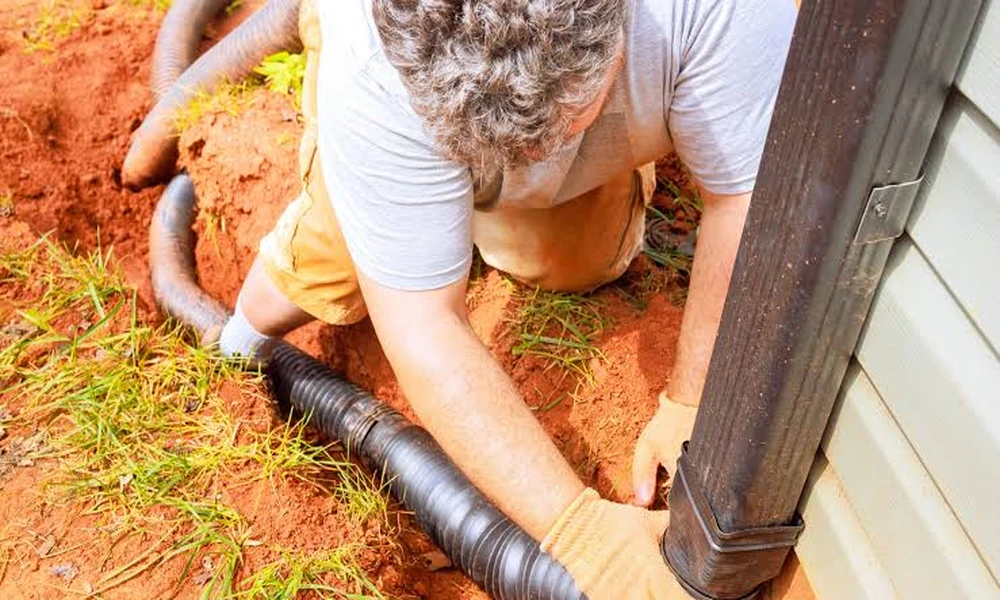
Underground drain lines offer a cleaner, permanent solution. A buried pipe connects to the downspout and carries water to a discharge point farther out in the yard, often ending in a pop-up emitter that opens when water flows and closes when it stops. The pipe must slope continuously so water does not sit and freeze inside it.
Dry wells and rain gardens let water soak into the ground at a safe distance. A dry well is a buried chamber of stone or a plastic tank that holds runoff while it slowly infiltrates the soil. A rain garden is a shallow planted basin where deep-rooted plants absorb and filter the water.
Collecting Water Instead of Moving It
Rain barrels capture runoff for watering gardens and lawns, which reduces the volume reaching the ground near the house. They fill quickly in a heavy storm, though, so every barrel needs an overflow hose that carries excess water the same safe distance as a standard extension.
Barrels should be drained and disconnected before the first hard freeze in the Chicago area. Water left inside can freeze and split the barrel, and a blocked inlet sends the full flow of the downspout back toward the foundation at the worst time of year.
Places Downspouts Should Never Drain
Downspouts should not empty onto a neighbor’s property, onto a sidewalk where water freezes into ice, or onto a driveway that slopes back toward the garage. Directing runoff onto adjoining land can also lead to disputes and liability.
Many Chicago-area municipalities prohibit connecting downspouts to the sanitary sewer, because storm runoff overwhelms the system during heavy rain and can contribute to sewage backing up into basements. Older homes sometimes still have these connections, so it is worth checking local rules and asking a professional whether yours should be disconnected.
Winter Considerations in the Chicago Climate
Freeze-thaw cycles make downspout planning more demanding here than in milder regions. Extensions that sit in low spots can fill with ice, and underground lines without enough slope can freeze solid and back water up into the gutters.
Snowmelt adds to the load in late winter and early spring, when the ground is still frozen and cannot absorb much water. During those weeks, discharge points need to sit where meltwater can flow freely across the surface instead of refreezing near the house.
Signs Your Current Setup Is Not Working
Watch for water stains or white mineral deposits on basement walls, a damp smell after storms, soil erosion or puddles near the foundation, and mulch washing away under the downspouts. Gutters that overflow during rain also point to clogs or undersized downspouts, which dump water exactly where you do not want it.
Gutter condition plays a role too. Sagging sections, loose hangers, and seams that drip during storms all release water before it ever reaches a downspout, which undoes the work of even the best discharge plan.
A quick check during a heavy rain often reveals the problem. Walking the perimeter with an umbrella shows where water lands, where it pools, and which downspouts need longer extensions or a different discharge plan.
Conclusion
Keeping a basement dry starts at the roof edge. Downspouts should carry water several feet from the foundation onto ground that slopes away, and never into the sanitary sewer or a neighbor’s yard. Extensions, underground lines, and dry wells each suit different properties and budgets.
Homeowners on Chicago’s North Shore who want a professional look at their gutters, grading, and drainage can rely on the team at LEN Roofing, a Northbrook company that has handled exterior projects since 2004.